
Exchange & SharePoint Server Licenses
Exchange Server is Microsoft’s on-premises mail and calendar server; SharePoint Server hosts intranet sites and documents. Each user also needs a CAL.
- 2
- 3
- 4
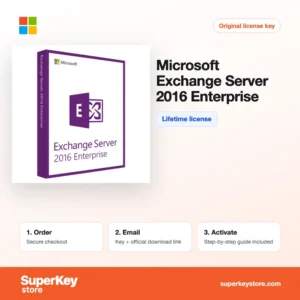
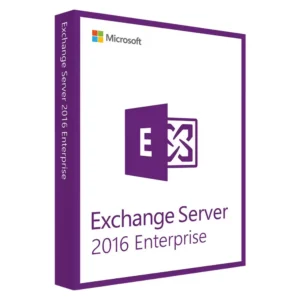
Buy Exchange & SharePoint Server Licenses at SuperKeyStore
This category serves organizations that run their own email and collaboration servers instead of, or alongside, cloud services. It is aimed at IT administrators, system integrators and companies with data-residency or compliance reasons to keep mail and documents in-house.
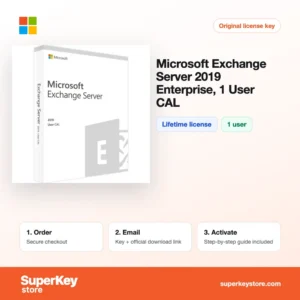
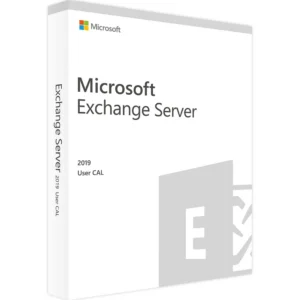
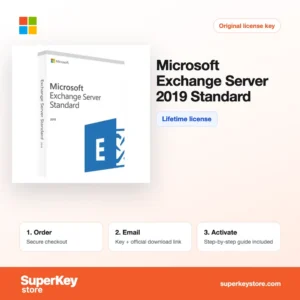
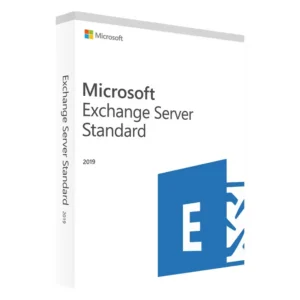
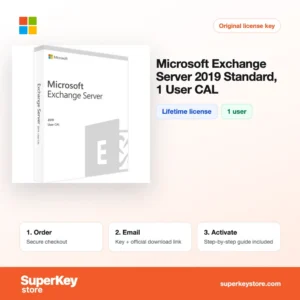
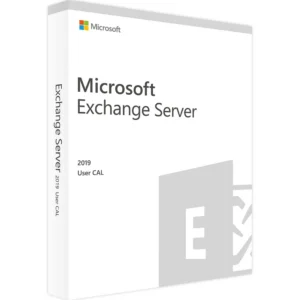
You will find server licenses such as Microsoft Exchange Server 2019 Standard and Microsoft Exchange Server 2019 Enterprise, plus the client access licenses (CALs) every user needs, for example Exchange Server SE Standard User CAL and SharePoint Server 2019 Standard User CAL. License keys and download information are sent by email, usually within minutes.
Why buy an Exchange Server license?
On-premises Exchange and SharePoint give a company full control over its communication data:
- Data stays on your hardware: Mailboxes and documents are stored in your own data center, which helps with strict privacy or industry rules.
- Full Outlook integration: Exchange provides email, shared calendars, contacts and tasks to Outlook on desktop, web and mobile.
- Built-in protection: Anti-malware filtering, data loss prevention and retention policies help protect and archive company mail.
- High availability: Database Availability Groups replicate mailboxes between servers, so mail keeps working if one server fails.
- Intranet and document sharing: SharePoint Server hosts team sites, document libraries with version history and internal portals.
What are the main features of Exchange Server?
Exchange Server and SharePoint Server offer a broad set of messaging and collaboration features:
1. Mailboxes, calendars and contacts
Exchange hosts user and shared mailboxes with calendars, contacts and tasks. Staff see free/busy times and book meetings and rooms directly in Outlook.
2. Outlook on the web and mobile access
Users reach their mail through Outlook on the web and through Exchange ActiveSync on phones. Field staff stay connected without a VPN client.
3. Compliance and retention
Retention policies, litigation hold and eDiscovery search keep mail for legal requirements. Regulated sectors such as finance and healthcare depend on these tools.
4. Database Availability Groups
Mailbox databases replicate to several servers with automatic failover. Larger companies keep mail running during maintenance or hardware failure.
5. SharePoint document libraries
SharePoint Server stores documents with version history, check-in and check-out, and permissions. Teams build intranet sites and shared workspaces.
Which Exchange or SharePoint product is right for you?
Choose Standard for up to five mailbox databases and Enterprise for larger deployments, then add one CAL per user.
| Product | Best for | Platform | License type |
|---|---|---|---|
| Microsoft Exchange Server 2019 Standard | Small and mid-sized organizations | Windows Server | Server license, up to 5 databases |
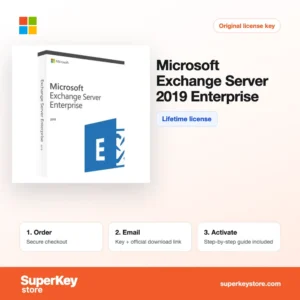
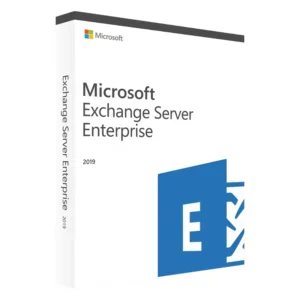
| Microsoft Exchange Server 2019 Enterprise | Large organizations with many databases | Windows Server | Server license, up to 100 databases |
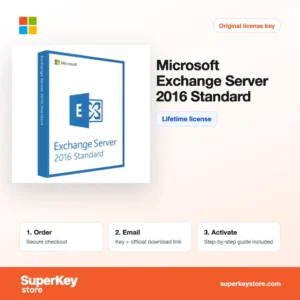
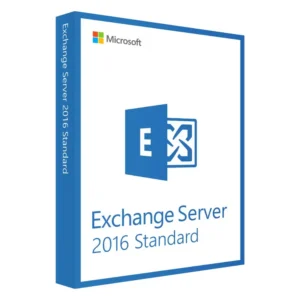
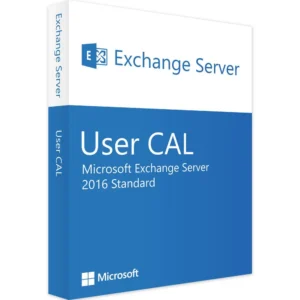
| Microsoft Exchange Server 2016 Standard | Existing 2016 environments | Windows Server | Server license |
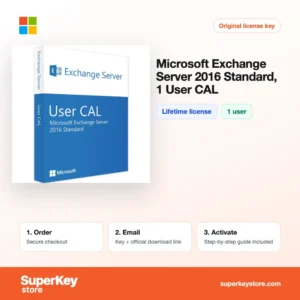
| Exchange Server 2019 Standard User CAL | Giving one user access to Exchange 2019 | Any client device | 1 user |
| Exchange Server 2019 Enterprise User CAL | Users who need advanced archiving and compliance | Any client device | 1 user, added to Standard CAL |
| SharePoint Server 2019 Standard User CAL | Access to SharePoint Server 2019 sites | Any client device | 1 user |
Exchange Server Subscription Edition (SE) is the current release that follows Exchange 2019; its CAL is listed as Exchange Server SE Standard User CAL. Older environments can still add Exchange Server 2016 Standard User CAL licenses.
What are the system requirements for Exchange Server?
Exchange Server 2019 and Exchange Server SE need a dedicated 64-bit Windows Server; check each product's System Requirements tab for the release you choose.
| Component | Minimum |
|---|---|
| Operating system | Windows Server 2019 or 2022 (Exchange 2019/SE); Windows Server 2025 is supported for newer builds |
| Processor | 64-bit Intel or AMD processor |
| Memory (RAM) | 128 GB recommended for Mailbox servers |
| Disk space | At least 200 GB free on the install drive, plus space for mail databases |
| Other | Active Directory domain; internet connection for updates and activation |
Microsoft recommends running Exchange on dedicated servers and not on domain controllers. Plan storage for mailbox growth, transaction logs and backups well above the minimum. For production use, test the design with Microsoft's Exchange sizing guidance before buying hardware.
How do you download and activate Exchange Server?
- Order: Buy the server license and the number of CALs you need.
- Email: Keys and download instructions usually arrive within minutes; a security check can take up to 24 hours.
- Download: Get the installation media from Microsoft's official download pages and install it on a supported Windows Server.
- Enter the product key: Add the key in the Exchange admin center or Exchange Management Shell to license the server.
What happens to my Exchange Server license if I reinstall or format my computer?
An Exchange product key is entered per server in the Exchange admin center or with Exchange Management Shell. If you rebuild a server, install Exchange again with the recovery setup option and enter the same key. CALs are not entered in software; they are a license right that you keep with your purchase records.
Can I move a Exchange Server license to a new PC or Mac?
Yes. You can move the server license to new hardware by decommissioning the old server and installing Exchange on the new one with the same key. CALs stay assigned to users or devices and do not need to be moved. Exchange runs only on Windows Server, not on Mac.
Keep proof of purchase for all server licenses and CALs together. During a licensing review, these documents show that every user and server is covered.
What if my Exchange & SharePoint Server key does not work?
Email our support team with your order number and a screenshot of the error in the admin center. We will provide a replacement key or a refund as set out in the Refund Policy.
Frequently asked questions about Exchange Server
Do I need CALs in addition to the server license?
Yes. Every user or device that accesses Exchange or SharePoint needs a CAL of the matching version, in addition to the server license.
What is the difference between Standard and Enterprise CALs?
The Standard CAL covers email, calendar and basic features. The Enterprise CAL is added on top for features such as in-place archiving and advanced data loss prevention.
Is Exchange 2016 still supported?
No. Microsoft ended extended support for Exchange 2016 and 2019 in October 2025, so new installations should plan for Exchange Server SE.
Can I use Exchange 2019 CALs with Exchange 2016?
Yes. CALs allow access to the same or an earlier server version, but not to a newer one.
Should I choose Exchange Server or Exchange Online?
Choose Exchange Server if you need data on your own hardware and have IT staff to run it. Exchange Online suits companies that prefer Microsoft to host mail.
How many CALs do I need?
You need one User CAL for each person who accesses Exchange, or one Device CAL per device, depending on the CAL type you buy.
Do I need a Windows Server CAL as well?
Yes. Users who access Exchange also need a Windows Server CAL for the underlying server.
Is Exchange Server SE a subscription?
Exchange Server SE requires active Software Assurance or a subscription license under Microsoft rules; check the product page for terms.
Related server licenses
Exchange and SharePoint need a Windows Server host; browse Windows Server Licenses & CALs. Desktop users will also need Outlook from Microsoft Office Licenses or Microsoft 365 Licenses.
What do you get after buying Exchange & SharePoint Server Licenses at SuperKeyStore?
You get an email with your license key, the official download link and step-by-step activation instructions. These items are included with every order:
- License key: the product key for the edition, term and number of devices named on the product page.
- Official download: a link to the installer on the developer's own website.
- Activation guide: the steps to install and activate the software, also shown in the Download & Activation tab.
- Order history: the key stays in your confirmation email and under My account.
- Email support: help with installation or activation from our support team.
Why buy software licenses from SuperKeyStore?
SuperKeyStore sells digital license keys with email delivery, secure checkout and a clear policy for faulty keys. The main reasons customers order here are:
- Digital delivery: no shipping; the key usually arrives by email within minutes of payment, and some orders get a security check of up to 24 hours.
- Clear product details: every product page states the edition, platform, license term and number of devices.
- Replacement or refund: if a key does not work, you get a working key or your money back, as set out in the Refund Policy.
- Secure payment: payments are processed by the payment provider; SuperKeyStore does not store full card details.
Other software licenses in the SuperKeyStore catalog
SuperKeyStore also sells licenses in these categories:
- Windows Licenses: Windows 11 Licenses · Windows 10 Licenses
- Microsoft Office Licenses: Office 2024 Licenses · Office 2021 Licenses · Office 2019 Licenses · Office 2016 Licenses · Microsoft Office for Mac Licenses · Microsoft Word, Excel & Office App Licenses · Microsoft Project Licenses · Microsoft Visio Licenses
- Microsoft 365 Licenses
- Antivirus Licenses: Norton Antivirus Licenses · McAfee Antivirus Licenses · Kaspersky Antivirus Licenses · Bitdefender Antivirus Licenses · ESET Antivirus Licenses · Avast Antivirus Licenses · AVG Antivirus Licenses · Panda Antivirus Licenses · VPN Licenses · Business Security Licenses
- Windows Server Licenses & CALs: Windows Server CAL & RDS CAL Licenses · Microsoft SQL Server Licenses · Exchange & SharePoint Server Licenses
- CAD & 3D Design Software Licenses: Autodesk Software Licenses · Graphisoft Archicad Licenses · SolidWORKS Licenses
- Graphic Design & Photo Software Licenses: Adobe Software Licenses · CorelDRAW Licenses
- PDF & Office Tools Licenses
- Backup & Data Recovery Software Licenses
- Video & Music Software Licenses
- Virtualization Software Licenses
- Office & Windows Bundle Licenses